
How LEED and EDGE-Certified Office Spaces Help Enterprises Meet ESG Goals in India
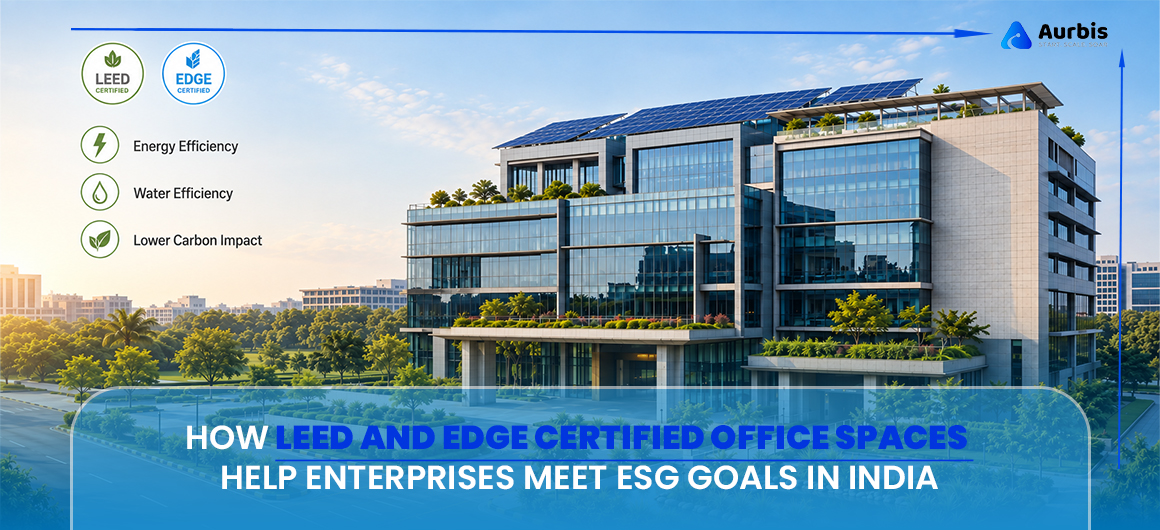
Enterprises across India are under growing pressure to show measurable progress on sustainability, not just state intent. For companies with active ESG programs or mandatory disclosure requirements, office space has become one of the more overlooked levers in that equation. The building a company leases contributes directly to its own environmental data, its emissions reporting, and in many cases its regulatory disclosures.
This is where LEED and EDGE certified office spaces come in. Both are recognised green building certifications, but they work differently and serve slightly different purposes for enterprise tenants. Understanding what each certification actually verifies, and how it connects to reporting frameworks like Business Responsibility and Sustainability Reporting (BRSR) and Scope 3 emissions, makes it much easier to evaluate office space as a genuine ESG decision rather than a real estate one.
What Is LEED Certification for Office Buildings?
LEED, Leadership in Energy and Environmental Design, is a globally used green building rating system developed by the U.S. Green Building Council. Certification is reviewed and verified by Green Business Certification Inc. LEED can be applied to office buildings, office interiors, and existing buildings, depending on the relevant rating system used.
LEED projects must meet mandatory prerequisites and earn points through credits across areas such as energy, water, waste, transportation, materials, and indoor environmental quality. The total points achieved determine the certification level: Certified, Silver, Gold, or Platinum, with each tier reflecting a progressively higher standard of sustainable design and performance.
For enterprises assessing office space, LEED certification provides a standardised, third-party verified indicator that a building has met defined sustainability requirements under the applicable LEED rating system. It is not simply a comparison against local code minimum construction. That said, tenants evaluating a space for their own ESG reporting should also request current operational data, such as energy use intensity, water consumption, renewable energy procurement, and indoor environment metrics, rather than relying on the certification tier alone.
What Is EDGE Certification for Office Buildings?
EDGE, Excellence in Design for Greater Efficiencies, is a green building certification system developed by the International Finance Corporation, part of the World Bank Group. It was designed to make resource-efficient building certification more accessible and is widely used across emerging markets, including India.
To achieve EDGE certification, an office building must demonstrate at least a 20 percent projected saving in energy use, water use, and embodied carbon in materials, measured against a standard local baseline building. Unlike LEED’s broader, points-based credit system, EDGE uses a more focused efficiency threshold across these three resource categories.
For enterprise occupiers, EDGE certification offers independently verified evidence of a building’s designed resource efficiency and can support property-related ESG disclosures. As with LEED, it should be supplemented with actual landlord or utility data where a company needs to report operational energy, water, or emissions performance for its leased space.
What Is the Difference Between LEED and EDGE Certification?
The two certifications differ in scope, process, and typical use case.
LEED evaluates a wider range of sustainability factors and is generally considered the more comprehensive certification. It requires more extensive documentation and a longer certification timeline, and its higher tiers, particularly Gold and Platinum, are widely recognised as strong indicators of sustainable building performance internationally.
EDGE is narrower by design. It focuses specifically on resource efficiency: energy, water, and materials, and is built around a clear, numeric threshold rather than a broader points-based system. This makes EDGE faster and often more cost-effective to achieve, which has made it a popular entry point for developers in India who want verified efficiency credentials without the full LEED certification process.
For enterprise tenants, the practical difference comes down to what they need for reporting. LEED offers broader credibility across more sustainability categories. EDGE offers specific, easily quantifiable efficiency data that maps cleanly onto energy and resource consumption metrics used in ESG disclosures.
How Does a LEED Certified Office Space Help Enterprises Meet ESG Goals in India?
For enterprises with active ESG commitments, whether driven by investor expectations, global parent company policy, or regulatory requirements, office space is a direct, measurable input into environmental reporting. A LEED-certified office space helps in three concrete ways.
First, it provides verified environmental performance data. Energy consumption, water usage, and material sourcing have already been assessed and certified by a recognised third party, which means the enterprise does not need to independently verify or estimate this data for its own reporting.
Second, it reduces the operational burden on internal sustainability and compliance teams. Instead of manually collecting building-level environmental data from property management, much of it is already documented as part of the certification process and can be requested directly from the landlord.
Third, it strengthens the credibility of the enterprise’s own ESG disclosures. Investors, auditors, and regulators increasingly expect underlying data to be independently verifiable rather than self-reported. A LEED-certified building gives enterprises a defensible, third-party validated data point to include in sustainability reports, rather than an internal estimate.
How Does LEED Platinum Certification Benefit Enterprise Tenants?
LEED Platinum is the highest certification tier, awarded to buildings that meet the most stringent thresholds across energy, water, materials, and indoor environmental quality. For enterprise tenants, particularly multinational companies and listed businesses with formal ESG mandates, Platinum certification carries specific advantages over lower tiers.
It signals the strongest available verification of a building’s sustainability performance, which matters when enterprise ESG disclosures are reviewed by external auditors or investors. It also typically correlates with the lowest operational energy and water costs among certified buildings, since Platinum requires the most substantial efficiency measures. For companies actively marketing their office locations as part of employer branding or client-facing sustainability commitments, a Platinum-certified address, such as those available in commercial hubs like Gurgaon, adds a further layer of external credibility.
What Energy Savings Does an EDGE Certified Office Building Provide?
EDGE certification is built around a specific efficiency threshold: a minimum 20 percent reduction in energy use, water use, and embodied carbon in materials, measured against a standard baseline building of the same type and location.
For enterprise tenants, this translates into measurable outcomes on two fronts. Operationally, lower energy and water consumption reduces utility costs over the life of the lease. For reporting purposes, the certification process itself generates the quantified savings data enterprises need to report accurate, verified figures rather than estimates, which is particularly useful for companies required to disclose energy intensity metrics as part of BRSR or investor ESG questionnaires.
How Do ESG-Certified Offices Help Companies With Sustainability Reporting?
Certified office space simplifies enterprise sustainability reporting in a very practical way: much of the underlying environmental data is already collected, measured, and independently verified as part of the building’s certification process.
This typically includes energy consumption data, water usage figures, and in some cases waste management and materials data. Instead of a corporate sustainability team requesting this information informally from property management and reconciling it manually, certified buildings generally maintain this data in a structured, auditable format that can be shared directly with tenants. This reduces both the time and the risk involved in enterprise ESG reporting, since the source data has already been validated by the certifying body.
What Is Scope 3 Emissions Reporting for Office Space?
Scope 3 emissions cover indirect emissions that occur across a company’s value chain, outside of its own direct operations (Scope 1) or purchased energy (Scope 2). Leased office space falls under Scope 3 for most enterprise tenants, since the building itself and the energy it consumes are owned and operated by a third-party landlord rather than the tenant company.
This is precisely why building certification matters for Scope 3 accuracy. Without verified data from the landlord, companies are often forced to estimate their office space emissions using generic industry averages, which weakens the accuracy of their overall emissions disclosure. A LEED- or EDGE-certified building provides actual measured energy and water data, allowing enterprises to report Scope 3 office space emissions with far greater precision.
What Is BRSR and How Does Office Space Affect It?
BRSR, Business Responsibility and Sustainability Reporting, is a mandatory disclosure framework introduced by the Securities and Exchange Board of India for listed companies, covering environmental, social, and governance performance in a standardised format.
Office space feeds into BRSR primarily through the environmental disclosure section, where companies are required to report on energy consumption, water usage, and related sustainability metrics. For listed enterprises leasing office space, using a certified building provides a documented, third-party verified source for this data, rather than relying on internal estimates that may not withstand regulatory or auditor scrutiny. As BRSR requirements continue to expand across more companies in India, verified building-level data is becoming a more material factor in overall compliance quality.
Which Managed Office Space Providers in India Have LEED or EDGE Certified Buildings?
A growing number of managed office space providers across India’s major commercial hubs, including Bangalore, Gurgaon, Mumbai, and Hyderabad, now offer LEED or EDGE-certified buildings as standard rather than as a premium exception. This shift reflects both developer investment in green building design and rising enterprise demand for certified space that supports ESG and regulatory reporting requirements.
For enterprises evaluating providers, the certification level, tier, and scope of available data sharing vary considerably between providers. It is worth confirming not just whether a building is certified, but whether the provider can supply the underlying energy and water consumption data required for tenant-level ESG reporting.
Which Aurbis Properties Are LEED or EDGE Certified?
The Aurbis portfolio includes LEED, EDGE, and GRIHA-certified or pre-certified properties across Bangalore, Gurugram, and Noida, giving enterprises multiple certified location options depending on their target market.
Bangalore
- Aurbis Connective, EPIP Zone, Whitefield: Pre-EDGE Certified
- Aurbis ORR, Outer Ring Road: EDGE Certified
- Aurbis Concord, Richmond Road: Pre-EDGE Certified
- Aurbis Prime, Koramangala: EDGE Certified
Gurugram
- Aurbis Summit, South City 1, NH 8: LEED Platinum Pre-Certified and GRIHA Certified
Noida
- Aurbis Renew, Sector 62: LEED Platinum Certified
Each of these certifications reflects a focus on energy efficiency, water efficiency, resource management, and sustainable building operations, giving tenants access to the kind of verified data enterprise ESG and BRSR reporting requires.
For enterprises evaluating certified office space in India, Aurbis’s portfolio combines operational efficiency with sustainability-focused building credentials across three major markets. Contact Aurbis to discuss which certified or pre-certified property fits your target location, whether that’s Bangalore, Gurugram, or Noida.
Conclusion
LEED and EDGE certification are no longer just markers of building quality. For enterprises managing active ESG commitments and regulatory disclosure requirements in India, they are a direct, verifiable input into Scope 3 emissions reporting and BRSR compliance. Choosing certified office space reduces the burden on internal sustainability teams, strengthens the credibility of enterprise disclosures, and in the case of EDGE and LEED Platinum buildings, delivers measurable operational savings alongside the reporting benefits.
As ESG expectations continue to tighten across Indian enterprises, office space is likely to become an increasingly visible line item in sustainability reporting. Choosing a certified provider now positions a company well ahead of that shift. Reach out to Aurbis to explore certified office space options that align with your enterprise’s ESG and reporting goals.
FAQs
Q: Why are enterprises choosing ESG-compliant office spaces in India?
A: Because leased office space falls under Scope 3 emissions and increasingly BRSR disclosure requirements, enterprises use certified buildings to access verified environmental data and reduce the effort and risk involved in their own sustainability reporting.
Q: Is EDGE certification recognised globally?
A: Yes. EDGE is developed by IFC, part of the World Bank Group, and is recognised internationally, with particularly strong adoption in emerging markets including India.
Q: Is ESG-certified office space available in Bangalore and Gurgaon?
A: Yes. Both cities have a growing number of LEED and EDGE-certified commercial buildings, including certified properties managed by Aurbis.
Q: Are green office buildings more expensive than regular offices?
A: Certified buildings can carry a marginally higher upfront cost, but this is typically offset over time by lower operational energy and water costs, along with reduced ESG reporting overhead for enterprise tenants.