
Inside Bengaluru’s GCC Surge: Why Tech Hubs Are Choosing Managed Spaces Over Warm Shells
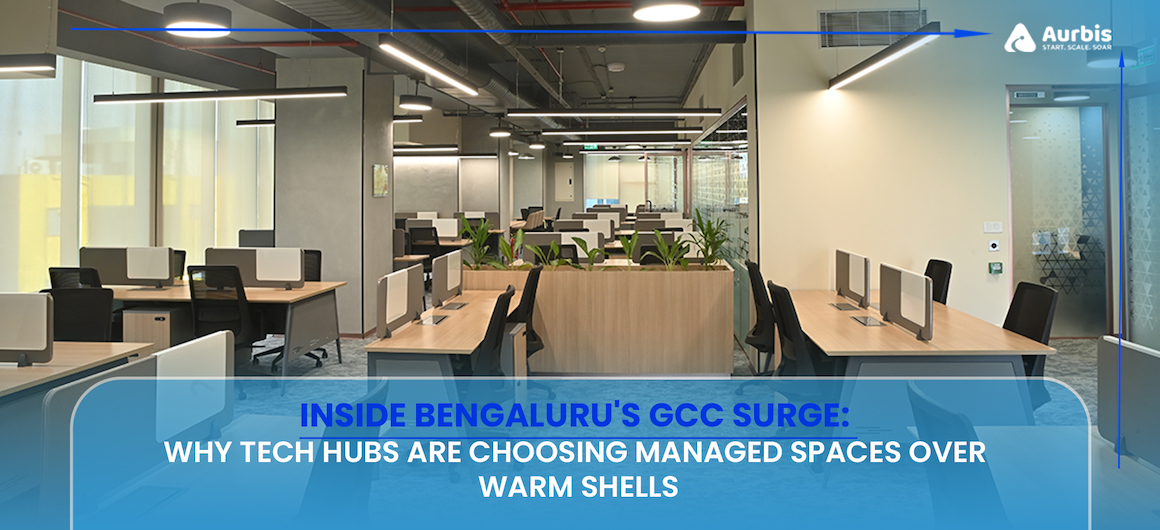
Bengaluru’s commercial office market is undergoing a significant transformation as Global Capability Centres (GCCs) expand their operations across the city. Once primarily associated with technology support and back-office functions, GCCs are increasingly involved in product development, artificial intelligence, engineering, analytics, and other strategic business activities.
This expansion is influencing not only how much office space global enterprises require but also how they evaluate, acquire, and manage it.
According to Colliers’ research, GCCs leased approximately 118 million sq. ft. of Grade A office space across India’s top seven cities between 2021 and the first half of 2026. During H1 2026 alone, GCC leasing reached 16.6 million sq. ft., accounting for 46% of Grade A office space uptake in the markets covered by the report.
As organisations establish new centres and expand existing operations, workspace decisions increasingly involve questions about speed, capital expenditure, operational responsibility and future flexibility.
This has brought the managed office vs warm shell comparison into sharper focus. A managed office generally offers a fitted-out workplace with contracted operational services, while a warm shell gives an occupier more responsibility for developing and managing its own interior workspace.
For companies evaluating GCC Bangalore managed office options in 2026, the central consideration is not simply which model offers a lower rental figure. It is which arrangement best supports business requirements over the intended period of occupation.
What Is Driving the Growth of GCCs in Bengaluru?
Bengaluru remains one of India’s most important locations for multinational technology operations. Its established technology ecosystem, skilled workforce, and commercial office infrastructure make it a prominent destination for companies establishing or expanding GCCs.
JLL’s research estimated that Bengaluru accounted for 34% to 39% of India’s overall GCC activity, reflecting its broad presence across technology, engineering research and development, and banking and financial services.
Several factors help explain this position.
Access to Specialised Talent
Global companies establish GCCs to access capabilities in software engineering, data analytics, artificial intelligence, cybersecurity, research and other specialised functions.
Bengaluru’s established technology sector provides access to experienced professionals and an ecosystem of companies working across these disciplines. Talent availability therefore remains an important consideration when multinational organisations select locations for their operations.
Expansion into Higher-Value Business Functions
The scope of GCC operations is also changing.
Colliers’ 2026 research identifies the growing importance of artificial intelligence, engineering, analytics, research and development, and digital functions within India’s GCC ecosystem.
These activities can create more specialised workplace requirements, including collaboration areas, secure technology infrastructure, meeting facilities and space for teams with different working arrangements.
Continued Demand for Grade A Commercial Offices
GCC expansion is contributing to demand for high-quality commercial buildings.
Bengaluru and Hyderabad together accounted for more than 60% of India’s GCC leasing between 2021 and H1 2026. The same research identifies Bengaluru’s Outer Ring Road corridor as a leading GCC micro-market, with Whitefield and North Bengaluru also among the important office locations.
These trends explain why GCC expansion in Bangalore discussions increasingly include workspace quality, location strategy, and readiness alongside conventional rental negotiations.
Why Are GCCs in Bengaluru Choosing Managed Office Spaces?
The growing relevance of managed offices is supported by measurable activity in India’s flexible workspace market.
According to Cushman & Wakefield’s report, GCCs accounted for 44% of all flexible workspace seats leased across India’s top eight cities during H1 2026, compared with 37% for the full year 2025.
Bengaluru led flexible workspace demand with 57,487 seats leased during H1 2026, representing 30% of the eight-city total. These figures demonstrate the role of GCCs in flexible office demand, although they do not establish that every GCC prefers managed space over conventional leasing.
For an expanding multinational enterprise, managed workspace arrangements can address several practical concerns.
- Reduced fit-out responsibility: Depending on the agreement, the workspace provider may coordinate interior development, furnishings and essential office infrastructure. This reduces the amount of fit-out work directly managed by the occupier.
- Operational support: Certain managed office contracts include services such as housekeeping, facilities management, utilities coordination, security arrangements and maintenance. The exact scope depends on the provider and contract.
- Flexibility in workspace planning: An organisation may prefer a workspace arrangement that accommodates planned team expansion without having to manage every aspect of premises development independently.
- More predictable service responsibilities: A clearly structured agreement can establish who is responsible for routine operations, infrastructure maintenance, and specific workplace services.
However, managed offices are not a single standardised product. Providers differ in their infrastructure specifications, contract structures, service inclusions, and customisation capabilities.
For this reason, a GCC Bangalore 2026 workspace strategy should assess the actual commercial agreement rather than assuming that every managed office delivers identical advantages.
Managed Office vs Warm Shell: What Is the Difference?
The difference between managed offices and warm shell premises lies primarily in the property’s readiness, the allocation of fit-out responsibility, and the ongoing workplace management arrangement.
A warm shell office generally includes the basic building infrastructure and certain essential systems but still requires tenant-specific interior development before it can operate as a fully functional office. Its precise condition depends on the developer’s handover specifications.
A managed office is typically delivered with an agreed workspace configuration, furnishings, infrastructure and operational service arrangements. The extent of those services must be verified with the provider.
| Comparison factor | Managed office | Warm shell office |
| Initial condition | Fitted-out or developed to agreed specifications | Base premises requiring tenant-specific fit-out |
| Fit-out responsibility | Often coordinated by the provider | Generally managed by the occupier |
| Initial capital expenditure | May be partly incorporated into contracted charges | Usually requires a separately funded fit-out |
| Time before occupation | Depends on readiness and customisation | Depends on fit-out scope, approvals and commissioning |
| Workspace customisation | Available within provider and contractual limits | Greater direct control over interior design |
| Facilities management | May be included under the service agreement | Usually arranged by the occupier |
| Expansion flexibility | Depends on available inventory and agreement terms | Depends on premises availability and lease provisions |
| Long-term cost | Depends on service charges, tenure and inclusions | Depends on rent, fit-out, operating costs and tenure |
Neither model is automatically preferable.
A multinational enterprise with a stable headcount forecast, a long-term lease requirement and highly specialised interior specifications may find a warm shell arrangement appropriate.
Conversely, an organisation seeking a more operationally ready workplace, with fewer separate fit-out and facilities-management responsibilities, may find a managed office more suitable.
The correct comparison involves total occupancy cost, operational control and suitability for business requirements, rather than base rent alone.
How Do Managed Offices Help GCCs Reduce Setup Time and Costs?
Establishing a new GCC involves several activities beyond identifying and leasing commercial premises. Organisations must consider workspace design, infrastructure procurement, technology installation, security requirements, staff facilities and operational readiness.
The extent of these activities depends on the condition of the property and the operational requirements of the business.
Reducing the Number of Separate Setup Activities
In a conventional warm shell arrangement, the occupier may need to coordinate interior designers, fit-out contractors, furniture suppliers, technology vendors and facilities-management providers.
A managed workspace arrangement can consolidate some of these activities under one provider, depending on the agreed scope.
This may reduce the internal coordination required from procurement, administration and real estate teams. However, organisations still need to undertake due diligence, approve specifications and confirm that their workplace requirements have been satisfied.
Managing Upfront Capital Expenditure
Warm shell premises typically require an additional investment to create a functional workplace. Potential expenditure includes workstations, partitions, meeting rooms, network infrastructure, lighting and interior finishes.
With managed offices, some of these costs may be incorporated into periodic occupancy charges or otherwise structured through the provider’s agreement.
This changes how expenditure is funded and contracted. It does not necessarily make the managed office less expensive over the complete occupancy period.
Companies should compare the total financial commitment under both arrangements, including fit-out costs, deposits, escalation clauses, maintenance, utilities, technology infrastructure, restoration obligations and termination provisions.
Improving Operational Readiness
An existing furnished and serviced workspace may allow an organisation to begin operations with fewer outstanding physical setup activities than an unfinished office.
However, there is no universally applicable GCC setup timeline. The duration depends on the size of the premises, the required configuration, contractual approvals, infrastructure availability, and any modifications needed before occupation.
For GCCs, the practical advantage is the opportunity to reduce direct involvement in certain workplace development and operational activities, subject to contract terms.
Can Managed Office Spaces Support Large-Scale GCC Expansion?
Managed offices are not necessarily limited to small teams or short-term business requirements. India’s flexible workspace sector now includes enterprise-oriented offerings alongside conventional coworking facilities.
Managed office spaces have evolved beyond traditional coworking environments to meet larger enterprises’ requirements. Many providers offer customised private offices, dedicated workspaces, and enterprise-focused infrastructure designed to support complex business operations. These arrangements can meet the needs of GCCs and multinational organisations that require more workspace capacity, privacy, operational support, and flexibility.
Nevertheless, a provider’s ability to accommodate large GCC operations must be evaluated individually.
Workspace Capacity and Configuration
A growing GCC may require dedicated floors, project areas, meeting rooms, training facilities, private cabins, and spaces for different business functions.
Companies should establish whether the proposed building can accommodate their current requirements and whether additional space is available for future growth.
An office advertised as having a large overall seating capacity does not necessarily have that number of contiguous, unoccupied seats available for immediate occupation.
Enterprise Infrastructure and Security
Technology-focused GCCs may have specific requirements involving network architecture, access controls, power backup, data protection, and business continuity.
Managed office providers may supply some of the underlying facilities, but enterprise IT teams should independently assess the technical specifications and the division of operational responsibilities.
Building security and physical access controls should also be evaluated against the occupier’s own organisational policies.
Long-Term Flexibility
Expansion arrangements may include additional dedicated office space, revised seating configurations, or access to larger premises as business requirements evolve. However, the availability of these options depends on the workspace provider’s existing capacity, property availability, and contractual terms.
Some GCCs may also adopt a hybrid workspace strategy, combining traditionally leased offices with flexible or managed office spaces to accommodate different operational needs. This approach allows organisations to balance long-term workspace requirements with the flexibility needed for future expansion.
For large-scale GCC operations, selecting an enterprise workspace in Bangalore requires careful consideration of current space requirements, infrastructure capabilities, operational flexibility, and anticipated business growth.
Why Is Whitefield Emerging as a Preferred Location for GCC Office Spaces?
Whitefield is an established commercial and technology corridor in eastern Bengaluru, attracting technology companies, multinational enterprises, and Global Capability Centres (GCCs). With its concentration of IT parks, commercial office developments, and supporting infrastructure, the area remains an important location for businesses establishing or expanding their operations.
For GCCs evaluating office locations in Bengaluru, Whitefield offers several advantages related to business infrastructure, connectivity, and access to enterprise-oriented workspaces. Its relevance to GCC location planning can be understood through three key factors.
An Established Technology and Office Ecosystem
Whitefield contains commercial office developments and established technology business districts, including the International Tech Park Bengaluru area and the EPIP industrial estate.
For companies seeking a tech hub office in Bangalore, the presence of existing commercial infrastructure makes Whitefield a relevant market to evaluate.
However, the suitability of any specific site depends on property quality, availability, workforce distribution, and operating requirements.
Metro Connectivity
Whitefield’s transport infrastructure has developed with the expansion of Bengaluru’s Purple Line.
Metro connectivity is an important factor to consider when evaluating office accessibility, particularly for organisations employing teams that commute from different parts of Bengaluru.
Actual commuting convenience depends on each employee’s starting location, transfers, station accessibility, and last-mile travel.
Availability of Enterprise-Oriented Workplace Options
Whitefield offers a range of enterprise-focused office spaces designed to accommodate the operational requirements of GCCs, technology companies, and multinational organisations.
Aurbis Connective, located in Whitefield, Bengaluru, is a managed office development offering a capacity of over 2,000 seats across G+3 floors. The property features plug-and-play infrastructure, high-speed internet, video conferencing rooms, power backup, and visitor management facilities.
One of its key location advantages is its proximity to Nellurhalli Metro Station, approximately 150 metres away, providing access to Bengaluru’s Purple Line Metro network. Its location within Whitefield also places it in an established technology and commercial office corridor.
For GCCs considering expansion in Bengaluru, Aurbis Connective represents an enterprise workspace option that can be evaluated for its capacity, connectivity, infrastructure, and operational suitability.
Organisations should assess workspace availability, customisation options, service inclusions, commercial terms, and future expansion requirements to determine whether the property aligns with their business needs.
What Should GCCs Consider Before Choosing a Managed Office in Bengaluru?
Selecting a managed office requires an assessment of the organisation’s operational, financial, and workforce requirements.
The following factors provide a practical framework for GCCs evaluating workspace options.
- Current and Future Space Requirements
Determine the number of workstations required, the proposed office attendance pattern, anticipated recruitment, and the need for collaboration or specialised work areas. Confirm whether future expansion is contractually supported or merely subject to availability.
- Total Occupancy Cost
Compare the complete financial commitment, including occupancy charges, deposits, management fees, utilities, maintenance, technology costs, escalation clauses, and exit obligations. Evaluate alternatives using comparable periods and service specifications.
- Workplace Infrastructure
Review the availability and technical specifications of power backup, network connectivity, meeting facilities, access controls, security systems and building services. Do not assume that standard facilities satisfy specialised enterprise requirements.
- Customisation and Organisational Identity
Establish what changes the provider permits to the floor plan, interiors, signage, meeting spaces and technology infrastructure. Clarify who owns installed assets and how changes are handled at the end of the agreement.
- Location and Employee Accessibility
Assess the building’s proximity to transport connections, relevant talent locations and essential amenities. Whitefield, Outer Ring Road and other Bengaluru business districts should be compared against actual employee and operational requirements rather than market reputation alone.
- Contractual Flexibility and Responsibilities
Review the agreement’s duration, notice periods, renewal conditions, permitted alterations, service-level obligations, and termination provisions. Confirm which facilities and operating services are included and which remain the occupier’s responsibility.
- Building Quality and Sustainability Requirements
Where sustainability and building performance are relevant to corporate policy, request supporting documentation for any environmental certification or performance claim. Certifications, energy performance, accessibility and other technical characteristics should be evaluated separately.
These considerations are especially relevant when the workspace supports strategic functions rather than temporary operations.
The most appropriate solution may be a managed office, a warm shell premises with a tenant-led fit-out, or a combination of different workspace formats.
Conclusion
Bengaluru’s GCC expansion is influencing the requirements placed on commercial workplaces. As multinational organisations establish and scale operations involving technology, engineering, research and other strategic functions, decisions about office infrastructure extend beyond rental rates and available floor area.
The growing participation of GCCs in India’s flexible workspace market demonstrates that managed offices have become a relevant component of enterprise real estate planning. However, this does not mean warm shell offices are becoming obsolete.
Managed office spaces may suit organisations prioritising operational readiness, consolidated service arrangements and reduced direct involvement in workplace development. Warm shell premises may remain appropriate where long-term control, extensive customisation and a tenant-led fit-out are central requirements.
For GCCs evaluating Bengaluru, including established commercial locations such as Whitefield, the decision should rest on total occupancy cost, infrastructure suitability, location, scalability and contractual clarity.
The goal is not simply to occupy an office faster. It is to choose a workspace arrangement that supports the organisation’s operating requirements and longer-term business plans.
FAQs
Q: Are managed offices more cost-effective than warm shell offices?
A: Managed offices can reduce the need for separately funded fit-outs and some direct workplace management responsibilities. However, they are not necessarily cheaper over a long occupancy period. The relative cost depends on rent, fit-out expenses, included services, contract duration, escalation clauses, and maintenance obligations. A like-for-like total occupancy cost comparison is necessary.
Q: How long does it take to set up a GCC office in Bengaluru?
A: There is no standard timeframe for establishing a GCC office in Bengaluru. A furnished, operationally ready workspace may require fewer physical setup activities than a warm shell office. However, occupancy timelines depend on space availability, customisation, infrastructure installation, contractual approvals, and internal operational readiness. Organisations should request a project-specific delivery schedule.
Q: Are managed offices suitable for long-term GCC operations?
A: Yes, managed offices can support long-term GCC operations when the available space, infrastructure, commercial terms and service arrangements match the organisation’s requirements. Suitability should be evaluated against workforce growth, operational control, expected occupancy duration and total cost. Long-term occupation does not automatically make conventional leasing preferable.
Q: Can managed office spaces be customised for enterprise requirements?
A: Some managed office providers offer customisation of seating layouts, meeting rooms, private work areas, branding and technology infrastructure. The extent of customisation varies by property and agreement. Enterprises should verify technical feasibility, additional charges, delivery responsibilities and restrictions before signing a contract.
Q: What is the difference between a managed office and a plug-and-play office?
A: A plug-and-play office generally describes a workspace that already has essential furnishings and infrastructure required for occupation. A managed office describes an arrangement that may also include ongoing facilities management and operational services. Although the terms are sometimes used together, an office advertised as plug-and-play does not necessarily include comprehensive management services.