
Smart Office Technology Explained: How IoT and BSMS Are Transforming Enterprise Workspaces in India
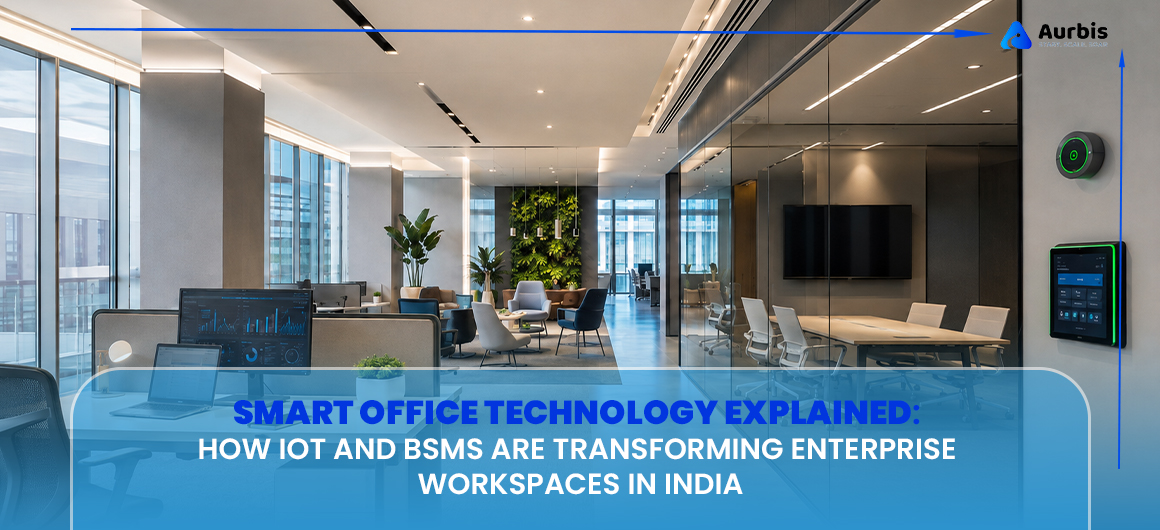
Enterprises evaluating office space in India are no longer just comparing square footage, lease terms, and location. Technology has become a core part of the decision. Smart office space solutions for enterprises now include connected building systems that monitor energy use, manage access, automate maintenance, and generate operational data that facility teams can act on in real time.
Two terms come up constantly in this shift: IoT and BSMS. IoT (Internet of Things) refers to the network of connected sensors and devices inside a building. BSMS (Building Services Management System) refers to the software layer that uses data from those devices to control and automate building operations. Together, they form the backbone of intelligent office systems, and they are quickly becoming a baseline expectation rather than a premium add-on for enterprise occupiers in India.
This article breaks down how these systems work, what separates a smart office from a conventional one, and what enterprises should look for when evaluating technology-enabled office space. If your team is currently comparing managed office space providers, understanding this layer of the decision will help you ask sharper questions during site visits and vendor discussions.
What Is The Difference Between A Smart Office And A Regular Office?
A regular office relies on manual processes. Lighting and air conditioning run on fixed schedules or manual switches. Maintenance happens on a routine calendar or only after something breaks. Access control is often a physical key or a basic card system with no data attached to it. Energy consumption is tracked, if at all, through a single monthly utility bill with no breakdown of where that consumption is happening.
A smart office replaces these fixed, manual processes with connected systems that respond to real conditions inside the building. Lighting adjusts based on occupancy. HVAC systems adjust based on actual usage patterns rather than a fixed timetable. Maintenance issues get flagged before they cause downtime. Access data becomes a searchable record rather than a physical formality. The core difference is not the presence of technology for its own sake; it is the shift from fixed schedules to responsive, data-driven building management.
For enterprises, this distinction matters because a smart office space directly affects operating costs, employee experience, and the availability of data needed for internal reporting and sustainability disclosures.
How Does IoT Technology Improve Enterprise Office Space Management In India?
IoT office space management works through a network of sensors placed across a building. These sensors track occupancy in meeting rooms and workstations, temperature and air quality across floors, energy consumption at the equipment level, and the status of critical systems like elevators, fire safety equipment, and water supply.
The value of this data comes from what happens after it is collected. Instead of a facility manager relying on periodic manual checks, IoT sensors provide a continuous stream of information. A rise in temperature in a server room, a spike in energy use on a specific floor, or an access point that has been left open longer than expected can all be flagged automatically rather than discovered later.
For enterprises operating in shared or managed office environments across Indian cities, this level of visibility solves a common problem: the disconnect between what a facility team assumes is happening in a building and what is actually happening. IoT closes that gap with real data rather than estimates.
What Is A Building Services Management System And How Does It Work?
Building Services Management System (BSMS) is the software layer that sits on top of IoT infrastructure. Where IoT sensors collect raw data, BSMS interprets that data and takes action, either automatically or by alerting facility staff.
BSMS typically manages HVAC scheduling and temperature control, lighting systems based on occupancy or time of day, fire and life safety monitoring, elevator and access control coordination, and utility consumption tracking across water and electricity.
The practical function of a BSMS smart building setup is coordination. Instead of each building system- lighting, cooling, security- running independently with its own controls, BSMS brings them into a single management framework. This reduces the manual workload on facility teams and creates a consistent operating standard across a property, which matters significantly when an enterprise occupies space across multiple locations or floors managed by different teams.
What Is The Difference Between BSMS And IBMS In Smart Buildings?
This is one of the most confused terms in the Indian commercial real estate and managed office market, so it is worth clarifying directly.
BSMS typically refers to the management of specific operational services within a building, such as HVAC, lighting, fire safety, and utilities. It is focused on the day-to-day running of building services.
IBMS (Integrated Building Management System) refers to the broader layer that integrates multiple systems, including BSMS functions, security systems, access control, and often IT infrastructure, into a single unified platform. Where BSMS manages individual services, IBMS is the umbrella system that connects those services together so they can be monitored and controlled from one interface.
In practical terms, a building can have a BSMS without a full IBMS, but a true IBMS office space will typically incorporate BSMS functions as one of its components. For enterprises reviewing technical specifications during a site evaluation, this distinction matters because a provider claiming “smart building technology” without clarifying which layer they operate at may only be offering partial automation rather than a fully integrated system.
How Does Smart Office Technology Reduce Energy Costs For Enterprises?
Energy cost reduction in a smart office comes directly from the automation described above, not from a separate feature. When HVAC systems adjust based on real occupancy data instead of running on a fixed schedule regardless of how many people are actually on a floor, energy waste from empty spaces is eliminated. When lighting responds to occupancy sensors rather than staying on for an entire shift, the same principle applies.
Predictive maintenance, enabled by continuous IoT monitoring, also plays a role. Equipment that is monitored for early signs of inefficiency, such as an HVAC unit drawing more power than its baseline, can be serviced before it becomes a larger energy drain or a full breakdown. This shifts maintenance from reactive to preventive, which tends to be less costly and less disruptive.
For enterprises with sustainability targets or internal cost reporting requirements, this level of automation also produces usable consumption data broken down by floor, zone, or system, rather than a single aggregated utility bill that offers no actionable detail.
How Does Workplace Automation Improve Productivity For Enterprise Teams?
Workplace automation solutions reduce the operational friction that otherwise falls on employees and facility staff. Meeting room booking systems integrated with occupancy sensors prevent rooms from being blocked on a calendar but left unused. Automated access control removes the need for manual sign-in processes at multiple checkpoints. Real-time space utilization data allows enterprise facility teams to understand which areas of an office are actually being used, which supports better decisions about space allocation as teams grow or shift to hybrid work patterns.
The productivity gain here is indirect but consistent. Employees spend less time dealing with building-related friction such as inconsistent room temperatures, unavailable meeting rooms, or manual access delays. Facility and admin teams spend less time on manual monitoring and more time on higher-value coordination work, since the system surfaces issues rather than requiring constant manual checks.
How Do Smart Office Buildings Support Sustainability And ESG Goals In India?
Smart sustainable buildings generate the kind of granular data that sustainability and ESG reporting increasingly requires. Energy consumption tracked at the system or floor level, rather than as a single building-wide figure, allows enterprises to identify specific areas where consumption can be reduced and to report on progress with actual data rather than estimates.
BSMS and IoT systems also support water usage monitoring, waste management coordination in some setups, and consistent tracking of building performance over time, which is useful when enterprises need to demonstrate year-over-year improvement as part of internal sustainability commitments or external disclosure requirements.
This connection between building technology and ESG reporting is becoming more relevant as enterprises operating in India face increasing pressure, both from global parent companies and from domestic stakeholders, to show measurable progress on environmental performance. A building that cannot produce granular consumption data makes this reporting significantly harder, regardless of how well-intentioned the sustainability targets are.
What Smart Office Features Should Enterprises Look For When Choosing Office Space?
When evaluating technology-enabled office space, enterprises should look past general claims of being a “smart building” and ask specific questions about the underlying systems. Relevant areas to assess include the extent of IoT sensor coverage across the building, whether the property has a functioning BSMS managing core services like HVAC and lighting, and whether that BSMS is integrated into a broader IBMS or operates as a standalone system.
It is also worth understanding what consumption and performance data the provider makes available to occupiers directly, since data that only the building operator can see is far less useful than data an enterprise can access for its own reporting. Finally, enterprises should ask how maintenance is handled, specifically whether the building relies on predictive maintenance enabled by IoT monitoring or still depends primarily on scheduled or reactive maintenance.
These questions during a site evaluation reveal whether a provider’s technology claims reflect a genuinely integrated system or a more limited set of individual features marketed under a broader smart building label.
What Is Aurbis One?
Aurbis One is the technology platform developed by Aurbis to manage building operations across its managed office properties. It brings together IoT-based monitoring and BSMS functions into a single platform used to oversee energy consumption, building services, and operational performance across Aurbis locations.
Rather than treating smart building technology as a separate feature layered on top of managed office space, Aurbis One is built into how Aurbis properties are operated day to day, giving enterprise occupiers a consistent technology standard across every Aurbis location rather than a feature set that varies by property.
How Does Aurbis One Technology Manage Building Operations?
Aurbis One applies the same principles described earlier in this article, with IoT sensor data feeding into a centralized management system at the level of daily building operations across Aurbis properties. This includes monitoring energy consumption across HVAC and lighting systems, tracking building service performance to identify maintenance needs before they become disruptions, and providing consistent operational oversight across all six Aurbis properties rather than managing each location independently. Visitor management system, meeting room & meal booking are all controlled and managed through Aurbis One.
This means enterprise clients occupying Aurbis space benefit from the same underlying technology standard regardless of which Aurbis location they operate from, which is particularly relevant for enterprises with teams distributed across multiple cities or planning future expansion within the Aurbis portfolio.
Why Choose Aurbis
Aurbis positions itself in the premium managed office space category in India specifically through the depth of its technology integration, not through generic office amenities. The combination of IoT-based monitoring and the Aurbis One platform means enterprise occupiers get access to operational data and building performance standards that go beyond what a conventional managed office typically offers.
For enterprises where facility performance, energy efficiency, and consistent building operations across locations are part of the evaluation criteria, this technology layer is a differentiator that directly affects day-to-day occupancy experience rather than a marketing feature disconnected from actual building performance.
Conclusion
The shift toward smart office space solutions for enterprises in India reflects a broader change in how office space is evaluated. IoT provides the real-time data. BSMS, and at a broader level, IBMS, provide the system that acts on that data to manage energy use, maintenance, and building services. For enterprises, the result is lower operating costs, better data for sustainability reporting, and a more consistent workplace experience.
Aurbis has built this technology directly into how its properties operate through the Aurbis One platform, giving enterprise occupiers a consistent standard of building intelligence across every location. Enterprises evaluating office space in India should treat this technology layer as a core part of the decision, not an afterthought, and Aurbis is built to meet that evaluation directly.
If your enterprise is evaluating smart office space in India, get in touch with Aurbis to see the Aurbis One platform in action and discuss which of our properties fits your team’s needs.
FAQs
Q: What is the difference between a smart office and a regular office?
A: A regular office runs on fixed schedules and manual processes for lighting, cooling, and access. A smart office uses connected sensors and automated systems that respond to actual occupancy and usage in real time.
Q: What is BSMS in a smart building?
A: BSMS stands for Building Services Management System. It is the software layer that manages core building services such as HVAC, lighting, fire safety, and utilities based on data collected from IoT sensors.
Q: How does IoT help manage office buildings?
A: IoT sensors continuously track occupancy, temperature, energy use, and equipment status across a building, giving facility teams real-time visibility instead of relying on periodic manual checks.
Q: How does building automation reduce electricity costs?
A: Automation adjusts HVAC and lighting based on actual occupancy rather than fixed schedules, which eliminates energy waste in unused spaces and supports predictive maintenance that prevents inefficient equipment from running unchecked.
Q: How does smart building technology help with ESG reporting?
A: Smart buildings generate granular consumption data at the floor or system level, which enterprises can use to track and report on energy and resource use over time rather than relying on a single aggregated utility figure.
Q: Which managed office space providers in India use smart building technology?
A: Providers vary in the depth of technology they offer, ranging from basic automation of individual systems to fully integrated platforms. Aurbis uses its Aurbis One platform to manage IoT and BSMS functions consistently across all its properties.
Q: What smart technologies are available in managed office spaces in India?
A: Common technologies include IoT-based occupancy and energy sensors, BSMS for managing HVAC and lighting, integrated access control, and predictive maintenance systems, with the level of integration varying significantly between providers.