
Top 5 Reasons to Choose Managed Office Space in Whitefield, Bangalore Over a Traditional Lease
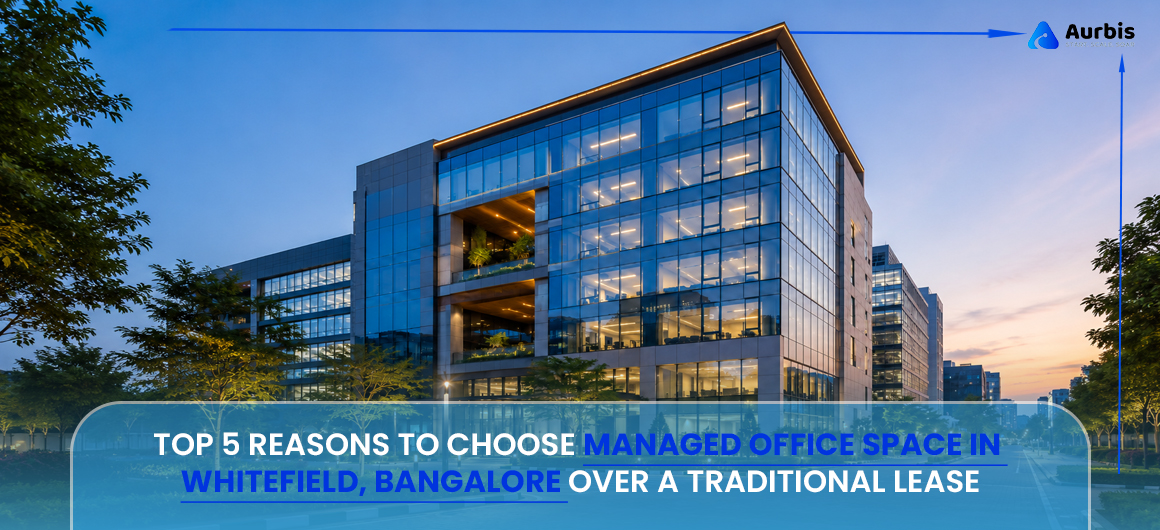
Whitefield is one of Bangalore’s established business corridors, attracting enterprises, global capability centres, technology companies, and growing corporate teams looking for well-connected, business-ready office spaces.
For companies planning to set up an office in Whitefield, one of the key decisions is choosing between a conventional commercial lease, where the business manages the workspace setup and operations independently, and a managed office space, where infrastructure, facilities, and day-to-day workplace management are handled by the workspace provider.
For businesses that value faster workspace readiness, flexibility, enterprise-grade infrastructure, and reduced operational complexity, managed office spaces in Whitefield can offer a practical method compared to conventional leases.
Why Choose Managed Office Space in Whitefield Over a Traditional Lease?
The difference between a managed office and a traditional lease extends beyond bare-shell or furnished workspaces.
Businesses also need to consider:
- How quickly can the office become operational
- How much capital and internal effort is required for setup
- Whether the headcount is likely to change
- What technology and workplace infrastructure employees need
- How accessible the location is for the workforce
These factors can significantly influence which office model is more suitable.
Here are five important factors businesses should consider when comparing managed office space with a traditional lease in Whitefield.
1. Get the Office Operational Faster
Setting up an office through a traditional lease can involve several stages after finalising the property.
Businesses may need to coordinate:
- Interior design and fit-out
- Furniture procurement
- Internet and network infrastructure
- Access and security systems
- Meeting room technology
- Power and backup infrastructure
- Facility management contracts
- Housekeeping and maintenance
- Workplace readiness
Each stage adds additional coordination before employees can begin operating from the office.
Managed office spaces reduce much of this setup burden because the core workplace infrastructure is already established or coordinated by the provider.
This can be particularly useful for companies establishing a new Bangalore operation, expanding a GCC, consolidating teams, or setting up a regional office where the priority is to become operational without independently building the workplace from the ground up.
2. Reduce the Complexity of Office Setup and Management
A traditional commercial lease gives a business considerable control over its workplace, but it also places more responsibility on the occupier.
Beyond paying rent, organisations may need to manage multiple service providers covering areas such as:
- Facilities
- Security
- Housekeeping
- Repairs and maintenance
- Internet and technology
- Utilities
- Workplace operations
- Vendor management
These requirements can become increasingly complex as the number of employees and the size of the workplace increase.
With a managed office, many of these responsibilities are coordinated through the workspace provider.
This can reduce the amount of internal time spent dealing with physical workplace operations while giving business and administrative teams more time to focus on employees, customers, and core operations.
For enterprise occupiers, the value of the model therefore lies not only in having a furnished office but also in simplifying how the workplace is operated.
3. Create a Workspace That Can Adapt to Business Growth
Office requirements rarely remain fixed for the entire duration of a company’s occupancy.
A business entering Whitefield may begin with one team and later add new departments, expand a GCC, introduce project teams, or restructure existing functions.
This makes scalability an important consideration when selecting office space.
Traditional offices can provide significant control over the layout, but changes may involve additional planning, fit-out work, capital investment, or alterations to existing infrastructure.
Managed workspace models are designed to provide greater flexibility around changing workplace requirements.
Depending on the provider and agreement, this can include:
- Changes in team size
- Different workspace configurations
- Additional meeting or collaboration areas
- Department-specific layouts
- Private office requirements
- Branding and design customisation
- Phased expansion
4. Access Enterprise-Ready Technology and Infrastructure
Modern workplaces depend on much more than desks and internet connectivity.
Enterprise teams increasingly require a combination of physical and digital infrastructure to support day-to-day operations.
This can include:
- Reliable high-speed connectivity
- Power backup
- Secure access systems
- Visitor management
- Video conferencing
- Meeting room management
- Facility service requests
- Workplace communication
- Environmental monitoring
- Operational reporting
When occupying a traditionally leased office, many of these systems need to be selected, installed, integrated, and maintained separately.
Managed offices can provide much of this infrastructure as part of the workplace environment.
Technology can also help simplify the way employees and facility teams interact with the office. Digital workplace platforms can bring activities such as access, visitors, bookings, service requests, and facility management into a more connected system.
For enterprise teams, the objective is not simply to have more workplace technology. It is to reduce fragmented processes and make everyday workplace operations easier to manage.
5. Choose a Location That Supports Employee Accessibility
Location remains one of the most important considerations when selecting an office.
A workplace may have strong infrastructure and amenities, but employee accessibility still affects the practical value of the location.
Companies evaluating office space in Whitefield should consider factors such as:
- Metro connectivity
- Access to major roads
- Employee commuting patterns
- Proximity to established business districts
- Nearby business infrastructure
- Accessibility for clients and visitors
Whitefield benefits from its established commercial ecosystem and metro connectivity, making it an important office destination for technology businesses, enterprises, and GCCs.
For companies specifically evaluating office space near Nellur Halli Metro Station, proximity to public transport can be an important consideration when comparing properties.
Managed Office vs Coworking vs Traditional Lease in Whitefield
Managed offices, coworking spaces, and traditional leases can all meet different workplace requirements.
Understanding where they differ can help businesses choose the model that best suits their team.
| Feature | Managed Office | Coworking Space | Traditional Lease |
| Workspace privacy | High, with dedicated workspace options | Often shared or partially private | High |
| Furnished workspace | Typically included | Typically included | Usually requires separate setup |
| Fit-out responsibility | Primarily provider-managed | Provider-managed | Primarily occupier-managed |
| Technology infrastructure | Can be designed for enterprise use | Typically designed for shared use | Selected and managed by occupier |
| Facility management | Provider-managed | Provider-managed | Occupier-managed |
| Workspace customisation | Often available | Usually more limited | High |
| Scalability | Designed for flexibility | Flexible, particularly for smaller teams | Depends on lease and property |
| Branding | Can be customised | Usually limited | High |
| Initial setup complexity | Lower | Lower | Higher |
| Enterprise suitability | High | Depends on team requirements | High |
| Operational responsibility | Lower for occupier | Lower for occupier | Higher for occupier |
A traditional lease may suit organisations with stable long-term requirements, internal real estate teams, and a preference for independently managing the entire workplace.
Coworking space can work well for individuals, smaller teams, distributed employees, and companies that value shared facilities and short-term flexibility.
A managed office sits between these models. It can provide the privacy and dedicated workplace environment expected by enterprise teams while reducing much of the setup and operational responsibility associated with a traditional office.
How is Managed Office Space Different From Coworking in Whitefield?
Managed office space and coworking are sometimes grouped into the same flexible workspace category, but the two models can serve different needs.
Coworking environments commonly focus on:
- Shared work areas
- Hot desks
- Smaller private offices
- Shared meeting facilities
- Community-oriented spaces
Managed offices are generally more suitable when an organisation requires a dedicated workplace environment with greater privacy, customisation, branding, infrastructure consistency, and operational control.
An enterprise managed office may include dedicated reception areas, private departments, secure access controls, customised meeting spaces, branded environments, and technology infrastructure designed around the occupier’s requirements.
For larger teams and GCCs, these considerations become a necessity when confidentiality, employee experience, security, and consistent infrastructure are priorities.
Which is Better for Enterprise Teams: Managed Office or Traditional Lease?
Neither model is automatically better for every business.
A traditional lease may be suitable when an organisation:
- Has stable long-term occupancy requirements
- Wants complete control over workplace design
- Has internal real estate and facility management resources
- Is comfortable making its own fit-out investment
- Wants to manage workplace infrastructure independently
Managed office space may be more appropriate when an organisation:
- Wants to establish operations faster
- Wants to reduce fit-out complexity
- Expects team requirements to change
- Needs a private enterprise environment
- Requires technology-ready infrastructure
- Wants customised workspace without managing the entire setup
- Is establishing or expanding a GCC
- Wants workplace operations handled through a single provider
The decision should therefore be based on business requirements rather than simply comparing rental costs.
Companies should also consider the cost and effort associated with fit-out, infrastructure, facility management, technology, maintenance, and internal workplace administration when comparing the two models.
What Should Enterprises Look for in a Managed Office Space in Whitefield?
Not every managed workspace provides the same level of infrastructure or service.
Enterprise occupiers should assess several factors before selecting a workspace.
- Location and Connectivity
Consider employee commuting patterns, metro access, road connectivity, and proximity to Whitefield’s major business areas.
- Workspace Privacy
Determine whether the office provides genuinely dedicated spaces for teams, departments, meetings, and confidential work.
- Technology Infrastructure
Review internet connectivity, power backup, meeting technology, security systems, visitor management, and digital workplace services.
- Ability to Customise
Enterprises may require specific layouts, branding, access controls, collaboration areas, executive offices, or department configurations.
- Scalability
Consider whether the workplace can accommodate future team growth or changes in workspace requirements.
- Facility Management
Understand which workplace operations are handled by the provider and which responsibilities remain with the occupier.
- Sustainability
Companies with ESG objectives may also want to consider energy management, water efficiency, waste management, indoor environmental quality, and green-building credentials.
Looking at these factors together provides a more useful assessment than comparing office spaces solely on price per seat.
Aurbis Connective as a Managed Office Option in Whitefield
For enterprises considering the managed office model, Aurbis Connective provides an example of how these requirements can be brought together within one workplace.
Located in Whitefield’s EPIP Zone, Aurbis Connective is a Pre-EDGE Certified Grade A workspace with more than 2,000 premium seats. An ideal location with excellent connectivity to public transport, proximity to major business districts & Bangalore International Airport.
The workspace includes features such as:
- Plug-and-play infrastructure
- High-speed internet
- Video conference rooms
- 100% power backup
- Visitor management
- Recreation areas
- Cafeteria facilities
- Parking
- Indoor air quality monitoring
- Power, water, and waste management systems
We also provide Aurbis One, our tech-enabled platform, to support functions such as visitor management, access controls, meeting room bookings, meal orders, service requests, helpdesk workflows, workplace communication, and operational monitoring.
Sustainability is thoughtfully integrated into the property through green-building principles and intelligent monitoring systems that track key areas such as indoor air quality, energy consumption, water usage, and waste management, helping create a more efficient and environmentally responsible workplace.
For companies comparing enterprise office options in Whitefield, these are practical factors to evaluate alongside location, workspace configuration, commercial terms, and future scalability.
Conclusion
Choosing between managed office space and a traditional lease in Whitefield depends on a company’s priorities around flexibility, infrastructure, operational responsibility, and long-term growth.
Conventional leases offer greater control but require businesses to manage fit-out, facilities, technology, and ongoing workplace operations. Managed offices simplify this process by providing ready infrastructure and professionally managed services.
For enterprises, GCCs, and growing teams, this means faster workplace readiness, greater scalability, and reduced operational complexity.
For businesses evaluating managed office space in Whitefield, Aurbis Connective offers an enterprise-focused workspace in the EPIP Zone with Grade A infrastructure, technology-enabled workplace management, sustainability features, and convenient access to Nallurhalli Metro Station.
FAQs
Q: How quickly can a team move into a managed office in Whitefield?
A: A managed office can significantly reduce setup time compared to a conventional lease building.. At Aurbis Connective, plug-and-play infrastructure, furniture, high-speed internet, meeting room facilities, power backup, and workplace operations are already in place, helping teams become operational with minimal setup.
Q: Is Whitefield good for enterprise office space?
A: Yes. Whitefield is an established business district in Bangalore with a strong presence of enterprises, GCCs, IT companies, and technology companies. Aurbis Connective is located in the EPIP Zone and combines enterprise-ready infrastructure with convenient access to Nallurhalli Metro Station and major business corridors.
Q: Is Aurbis Connective located in Whitefield?
A: Yes. Aurbis Connective is located in the EPIP Zone, Whitefield, Bangalore. It is a Pre-EDGE Certified Grade A managed and sustainable workspace designed for enterprises, GCCs, corporate teams, and growing businesses.
Q: Is Whitefield metro connected?
A: Yes. Whitefield is connected to Bangalore’s metro network. Aurbis Connective is approximately 150 metres from Nallurhalli Metro Station, making public transport easily accessible for employees and visitors.
Q: Is managed office space more expensive than a conventional lease?
A: Not necessarily. The rental rate alone does not provide a complete comparison. A conventional lease can involve additional costs for fit-outs, furniture, technology, facility management, maintenance, and vendor coordination, while a managed office brings with it most of these requirements into one professionally managed solution. Aurbis focuses on cost optimisation through shared infrastructure, flexible leasing, managed operations, and reduced setup complexity.
Q: Can a managed office space in Whitefield support a 100+ person enterprise team?
A: Yes. Our managed workspace in Whitefield is designed for enterprises, GCCs, and large corporate teams and offers 2,000+ premium seats at its Whitefield location. Aurbis Business Parks also supports customised layouts and scalable workspace planning based on team structure and growth requirements.
Q: Are meeting rooms and conference facilities included or charged separately?
A: Aurbis Connective provides meeting rooms and video conferencing facilities as part of its enterprise workplace infrastructure. Specific access, allocation, or commercial terms vary depending on the workspace configuration and agreement, so these requirements can be discussed during the planning stages with Aurbis.
Q: Is IT infrastructure, like dedicated internet connectivity and server rooms, available in managed office space?
A: Yes. We provide enterprise-ready digital infrastructure, including high-speed internet with redundant bandwidth, IT and network integration support, secure access systems, and AV-enabled video conferencing. Dedicated IT requirements can be planned around an organisation’s needs, while requirements such as dedicated server rooms should be confirmed based on the selected workspace configuration.