
Why Managed Office Space Is the Fastest Growing Commercial Real Estate Segment in India
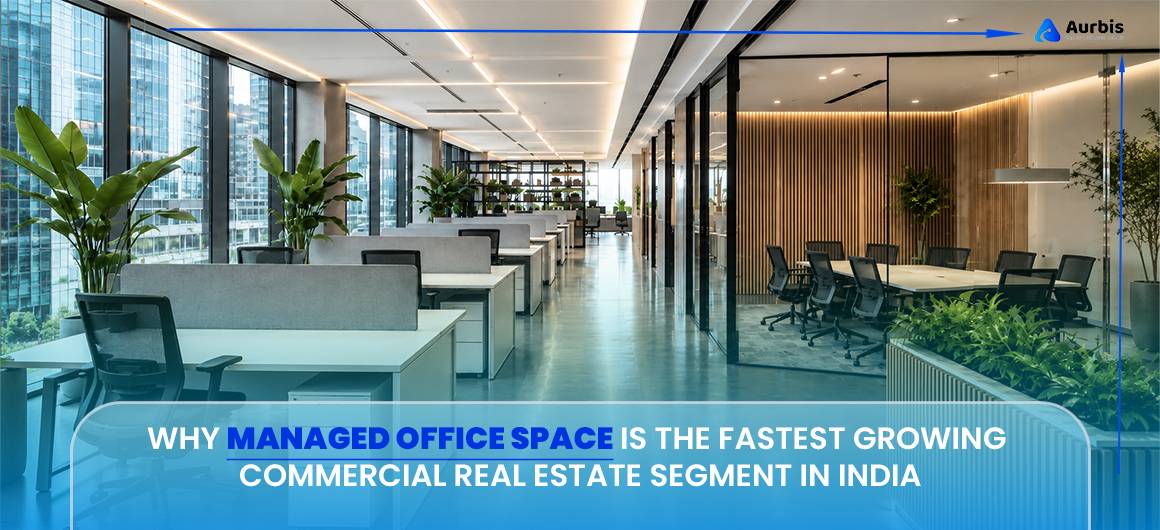
Managed office space has become the fastest-growing segment in India’s commercial real estate market, and enterprises are the ones driving it. As companies look for faster occupancy, lower upfront costs, and more flexible terms, the flexible office space market in India is expanding well ahead of traditional leasing. This shift is reshaping commercial real estate trends across India heading into 2025, and it is changing how enterprises think about office space altogether.
For companies evaluating their next office move, understanding why this shift is happening and what it means for cost, speed, and scalability is now a practical business decision rather than a niche real estate topic.
What Is Managed Office Space?
Managed office space is a fully fitted-out workspace where the operator, not the tenant, handles furniture, IT infrastructure, facility management, and regulatory compliance. The enterprise simply moves in and starts operating, without arranging a fit-out, procuring equipment, or managing vendors. This is fundamentally different from a traditional bare shell lease, where the tenant is responsible for every stage of setup before the space is usable.
Because everything from workstations to internet connectivity is already in place, managed office space is often described as a plug-and-play office model. It removes the operational burden of setting up a workspace and replaces it with a ready-to-use environment from day one.
Why Is Managed Office Space Growing Faster Than Traditional Leases in India?
Managed office space is growing faster than traditional leases in India because it removes the two biggest friction points of conventional leasing: time and capital. A traditional lease typically requires 12 to 18 months between signing and occupancy, once fit-out, approvals, and vendor coordination are accounted for. A managed office space can be occupied in a fraction of that time, since the fit-out, furniture, and infrastructure are already in place.
Capital exposure is the second factor. Under a traditional lease, the tenant bears the upfront cost of fit-out, furniture, and infrastructure, often running into significant capital expenditure before a single employee moves in. Managed office space shifts this cost to the operator, converting a large capital outlay into a predictable operating expense.
The third factor is flexibility. Enterprises today do not want to commit to a fixed footprint for five to nine years, particularly with hybrid work models still evolving. Managed office space allows companies to scale seats up or down based on actual headcount, rather than locking into a fixed area regardless of how their workforce needs to change. Together, these three factors- speed, capital efficiency, and flexibility- explain why managed office space is consistently outpacing traditional leasing as a share of new commercial real estate transactions in India.
What Is Driving Demand for Managed Office Space in Indian Cities?
Demand for managed office space in Indian cities is being driven primarily by the expansion of Global Capability Centers, or GCCs, into India. Multinational companies are setting up GCC office space in India at a rapid pace, and managed office space allows them to establish a functional presence quickly, without the delays of a traditional lease or the burden of managing local real estate independently.
The IT and ITES sector, along with BFSI, continues to be a major demand driver as well. These sectors have hiring cycles that do not always align neatly with long lease commitments, making a flexible, scalable model more practical for their workforce planning.
A third driver is the broader trend of multinational companies entering India without established local real estate expertise. For a company setting up its first India office, navigating lease negotiations, local compliance, and vendor management independently is a significant undertaking. Managed office space for enterprises removes much of that complexity, since the operator has already built the local expertise the enterprise would otherwise need to develop from scratch.
How Is Managed Office Space Different From Co-Working Space in India?
The core difference between managed office space and co-working space in India is exclusivity and control. Co-working space is a shared, open-plan environment where multiple unrelated companies operate within the same space, often on a hot-desk or shared-seating basis. It is designed for individuals, freelancers, and small teams that do not need a dedicated, branded environment.
Managed office space, by contrast, is a dedicated, single-tenant space. The enterprise gets exclusive use of the area, with the ability to apply its own branding, security protocols, and access controls, while the operator still handles the underlying infrastructure and facility management. This makes managed office space a better fit for enterprise teams that need privacy, security, and an environment that reflects their own company culture, rather than a shared, multi-tenant setup.
In practice, the coworking versus managed office decision often comes down to team size and the need for a dedicated, enterprise-grade environment.
What Are the Benefits of Managed Office Space for Enterprise Teams?
Enterprise office space in India built on a managed model offers several distinct advantages over the traditional leasing route. The most significant benefits include:
- Cost predictability
Because fit-out, maintenance, and utilities are bundled into a single operating cost, enterprises can budget with far more accuracy than under a traditional lease, where costs such as maintenance and repairs can vary month to month.
- Faster onboarding
Since the space is already built and equipped, new teams can be operational within days or weeks rather than months, which matters significantly when an enterprise is scaling quickly or entering a new city.
- Built-in compliance
Managed office operators typically handle fire safety, building compliance, and other regulatory requirements as part of the service, reducing the compliance burden on the enterprise itself.
- Scalability
Teams can expand or contract their footprint based on actual headcount, rather than being locked into a fixed area for the length of the lease term.
- Reduced facilities overhead
Enterprises no longer need an internal team dedicated to managing vendors, repairs, and day-to-day facility issues, since this is handled by the operator.
Taken together, these benefits explain why managed office space has become a serious alternative to traditional leasing for enterprise teams, not just a stopgap solution.
How Does Managed Office Space Help Enterprises Reduce Costs?
Managed office space helps enterprises reduce costs primarily by eliminating upfront fit-out capital expenditure. Under a traditional lease, a company might need to invest significantly in interiors, furniture, and IT infrastructure before the space is usable, capital that is tied up in the office rather than the core business. Managed office space removes this requirement entirely, since the space arrives fully equipped.
Bundled utilities and maintenance are a second cost factor. Instead of managing multiple vendor relationships for electricity, internet, housekeeping, and repairs, enterprises pay a single predictable fee that covers all of this. This also reduces the administrative overhead of managing those vendor relationships directly.
Finally, managed office space is typically priced on a predictable per-seat basis, which contrasts with the variable cost structure of a traditional lease. Traditional leases often involve Common Area Maintenance, or CAM, charges, periodic maintenance costs, and security deposits, all of which can fluctuate and are difficult to forecast precisely. A per-seat managed office model gives finance teams a clearer, more stable number to plan around.
Which Cities in India Have the Highest Demand for Managed Office Space?
Demand for managed office space in India is concentrated in a handful of key cities, each shaped by its dominant industry base. Bangalore leads demand due to its concentration of IT companies and Global Capability Centers, making it a natural hub for enterprises setting up technology-focused teams. Hyderabad follows closely, driven by a strong presence of both IT and pharmaceutical companies establishing operations in the city.
Pune has seen rising demand tied to its automotive and IT sectors, while the National Capital Region, particularly Gurugram, has become a major hub for corporate headquarters and BFSI companies. Mumbai continues to see steady demand as India’s financial capital, with enterprises across banking, financial services, and corporate sectors seeking flexible office solutions. Each of these cities reflects a different demand driver, but all point to the same underlying shift toward flexible, enterprise-ready office space.
How Much of India’s Commercial Real Estate Market Does Managed Office Space Represent?
Managed and flexible office space now accounts for a significant share of all new office leasing activity in India, based on recent market data. Flex and managed operators have contributed a substantial portion of total office leasing across the country’s major cities in recent quarters. In some cities, the share has been notably higher, reflecting how strongly enterprise demand has shifted toward this model in certain markets. This momentum has continued into subsequent quarters as well, with flex operators taking a growing share of office leasing in some of the country’s most active flex markets, underlining how quickly this share is rising.
A large part of this growth is being driven by Global Capability Center expansion into India. GCC demand, alongside flex workspace uptake, has kept India’s overall office leasing on a growth path even as some other segments of demand have cooled. This is echoed in broader market reporting on flex space leases, which similarly points to flex space leasing surging even as overall office demand softens, reinforcing that managed and flex space is outperforming the broader market rather than simply growing alongside it.
The picture looks different when measured against total existing office stock rather than new leasing activity. Because traditional office space has accumulated over decades while managed and flex supply is still scaling, managed office space currently makes up a smaller share of overall inventory nationally, though the proportion varies depending on the city and how flex space is defined across different industry reports. Bengaluru, Pune, and Hyderabad tend to show higher penetration than more traditional markets. This distinction between fast-growing leasing share and slower-moving stock share is consistent with the broader trajectory described in industry analysis of India’s commercial real estate market, which frames flex and managed space as a structurally growing segment within the wider market rather than a short-term cyclical trend.
Taken together, these points point to the same underlying story: while managed office space still represents a smaller slice of total office stock, it is already one of the largest single contributors to new office leasing in India, and its share continues to grow as enterprises increasingly choose this model over traditional leases.
Which Managed Office Space Providers Are Considered Among the Best in India?
Choosing a managed office space provider in India should come down to a few practical criteria: track record in delivering quality spaces, breadth of portfolio across cities and micro-markets, scope of services included in the offering, and depth of local expertise in the specific location an enterprise is targeting. A provider that understands the nuances of a specific micro-market, rather than offering a generic footprint across cities, is typically better positioned to serve enterprise needs precisely.
Aurbis is an example of a provider built around this kind of location-specific expertise, with a presence in key micro-markets such as Whitefield in Bangalore, where enterprise and GCC demand is particularly concentrated. Rather than evaluating providers purely on the number of cities covered, enterprises are better served by assessing how well a provider understands the specific market they are entering and whether their service scope genuinely reduces the operational burden on the tenant.
Managed Office Space Is Becoming the Default Choice for Enterprises in India
The shift toward managed office space in India is not a temporary trend; it reflects a fundamental change in how enterprises think about real estate: as a flexible, predictable operating cost rather than a fixed, capital-intensive commitment. For companies planning their next office move, whether entering India for the first time or scaling an existing footprint, managed office space offers a faster, more cost-predictable path than the traditional lease model it is steadily replacing.
Get in touch with Aurbis to explore managed office space options tailored to your enterprise needs.
FAQs
Q: What is the difference between managed office space and co-working space?
A: Managed office space is a dedicated, single-tenant environment where one enterprise has exclusive use of the space, along with its own branding and security controls. Co-working space is shared and open-plan, typically used by multiple unrelated companies or individuals on a hot-desk basis.
Q: Is managed office space cheaper than a traditional lease in India?
A: Managed office space generally reduces total costs because it eliminates upfront fit-out capital expenditure and bundles maintenance and utilities into one predictable fee. Traditional leases often carry variable costs such as CAM charges and periodic maintenance that are harder to forecast.
Q: What does fully managed office space include?
A: Fully managed office space typically includes furniture, IT infrastructure, internet connectivity, facility management, housekeeping, and compliance handling, all provided by the operator. The enterprise moves in and begins operating without arranging any of these elements independently.
Q: Which cities in India have the most managed office space?
A: Whitefield in Bangalore and Gurgaon in the National Capital Region are two of the most concentrated managed office hubs in India. Whitefield has grown around its dense cluster of IT companies and Global Capability Centers, while Gurgaon has developed as a hub for corporate headquarters and BFSI companies.
Q: Which companies are choosing managed office space over traditional offices in India?
A: Global Capability Centers, IT and ITES companies, and multinational companies entering India for the first time are among the most common adopters of managed office space. These companies typically prioritize speed of setup and reduced local real estate complexity over the long-term cost advantages that traditional leases can offer at scale.
Q: Is managed office space a good option for MNCs setting up in India?
A: Managed office space is well suited to multinational companies setting up in India, since it removes the need to independently navigate local real estate negotiations, compliance, and vendor management. This allows an MNC to establish a functional office presence quickly, without first having to build local real estate expertise.
Q: Why are companies moving from traditional offices to managed spaces?
A: Companies are moving to managed spaces largely due to internal pressure from finance and HR teams to reduce fixed costs and unpredictable facility expenses. A managed model converts a large, variable real estate commitment into a predictable operating cost that is easier to plan around and adjust as headcount changes.